Research tracker
Idaho Short-Term Rental Laws, Taxes and Local Rules: 2026 Tracker
Idaho preempts cities and counties from banning short-term rentals. Qualifying taxable short-term lodging starts with an 8% state baseline (6% sales tax + 2% Travel and Convention Tax), and 23 cities add local-option taxes that can push the verified total as high as 22%.
All 64 records verified against primary sources July 29, 2026 · Dataset version 2026-07-29 · Statewide preemption effective July 1, 2026 (HB 583)
Island Park Property Management Island Park Property Management Research is the independent research and reference section of IslandParkPropertyManagement.com.
Last verified: July 29, 2026 · Dataset version: 2026-07-29 · 64 published records
What are the key Idaho short-term rental statistics for 2026?
The fastest answer is that Idaho separates operating regulation from tax compliance. The 2026 law bars city and county operating permits, while the verified tax stack still changes by city and exact auditorium-district address.
- Idaho short-term rental laws and primary tax sources produce a verified 2026 lodging-tax range of 8% to 22% for the exact address conditions in this tracker — a 14-point spread from the state-only baseline to Sandpoint (Island Park Property Management Research analysis of state, district, and municipal rates; July 29, 2026).
- Every qualifying taxable short-term lodging stay in Idaho starts with an 8% state baseline in 2026: 6% sales tax plus 2% Travel and Convention Tax (Idaho State Tax Commission; verified July 29, 2026).
- The Idaho State Tax Commission lists 23 cities with a local sales tax but publishes no city rate on that list, directing taxpayers to the issuing cities instead (City Sales Tax page updated January 13, 2026; verified July 29, 2026).
- Idaho Code § 67-6539 enumerates 17 short-term-rental-only requirements that local governments may not impose and 5 safety requirements they may impose after July 1, 2026 (House Bill 583; verified July 29, 2026).
- Since July 1, 2026, no Idaho city or county may require a license, fee, permit, certification, or registration to operate a short-term rental; tax permits and filings remain separate obligations (Idaho Code §§ 67-6539(5) and 63-1804; verified July 29, 2026).
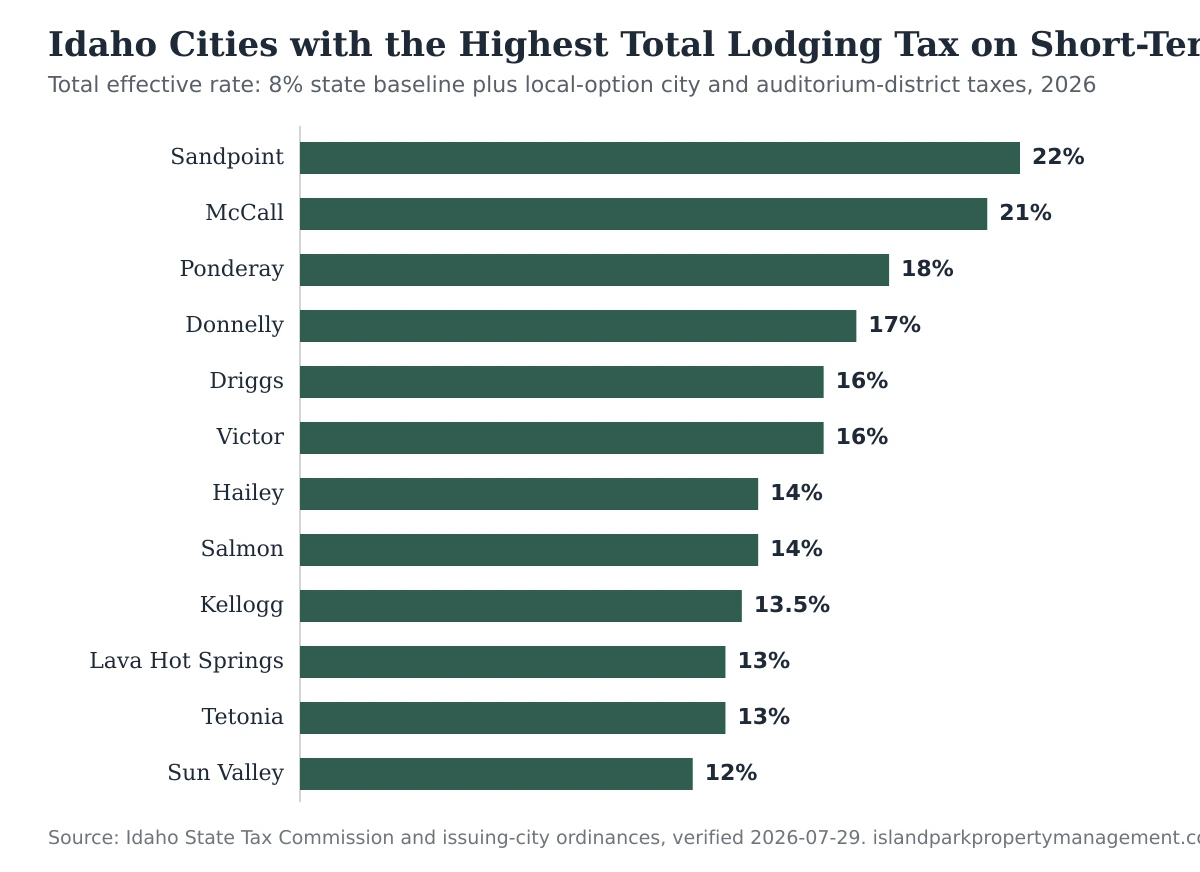
- Sandpoint has the highest verified total in this dataset at 22% in 2026: a 14% city short-term-rental occupancy tax plus the 8% state baseline for a qualifying address inside city limits (City of Sandpoint; verified July 29, 2026).
- A qualifying McCall address inside the Mountain Community Center District carries a 21% published tax stack in 2026: 8% state, 5% district, and the city’s current published 8% lodging-business total (City of McCall and Idaho State Tax Commission; verified July 29, 2026).
- Ponderay’s verified total is 18% in 2026: 10% occupancy tax plus the 8% state baseline; the city’s separate 1% general-sales ordinance expressly excludes occupancy sales (City of Ponderay Ordinances 143R and 150R; verified July 29, 2026).
- A qualifying Donnelly address inside the Mountain Community Center District carries a 17% total in 2026: 8% state, 5% district, and 4% city tax because Donnelly’s instructions apply both its 1% sales tax and 3% occupancy tax to lodging (City of Donnelly and Idaho State Tax Commission; verified July 29, 2026).
- Idaho’s current state list contains 5 auditorium districts, each charging 5% on qualifying short-term lodging inside its boundaries (Idaho State Tax Commission; verified July 29, 2026).
- The Mountain Community Center District began 5% collection on June 1, 2026, according to the Idaho State Tax Commission’s dated March 31, 2026 press release.
- Driggs raised its lodging category from 6% to 8% effective January 1, 2026 after the November 4, 2025 vote (City of Driggs, Ordinance 494-25; verified July 29, 2026).
- Idaho Code § 63-1804(5) makes a direct-rental owner comply with the requirements the section applies to a short-term-rental marketplace when the owner offers the rental without a marketplace, effective July 1, 2026.
- City local-option tax is remitted to the issuing city rather than the Idaho State Tax Commission, so a direct booking in a local-tax city uses a state filing channel and a separate city filing channel (Idaho State Tax Commission; verified July 29, 2026).
- Island Park is absent from the state’s current 23-city local-tax list, and Island Park/Fremont County is absent from its current 5-district list, leaving the 8% state baseline as the published stack for a qualifying exact address meeting those conditions (Idaho State Tax Commission; verified July 29, 2026).
What is the headline finding?
Idaho’s 2026 short-term-rental framework is simple only at the statewide level: cities and counties lost the power to condition operation on a local permit, but taxes remain layered. For the exact address conditions verified here, a qualifying lodging transaction ranges from 8% in Island Park/Fremont County to 22% in Sandpoint, and the rate depends on state tax, city limits, and auditorium-district boundaries.
The missing public record was not another summary of House Bill 583. It was the joined table: the state statute, the 8% state baseline, all 23 cities on the Tax Commission’s city list, all 5 auditorium districts, the local tax base that determines whether components combine, and a dated implementation-status field for local pages that have not caught up with the new law.
The practical consequence is visible in two cabins with the same taxable nightly charge. A qualifying Island Park address meeting the named-list conditions carries the 8% state baseline; a qualifying McCall address inside MCCD carries a 21% stack because both the city and district layers apply.
What do Idaho short-term rental laws say after House Bill 583?
House Bill 583 took effect July 1, 2026 and amended both Idaho Code § 67-6539, which governs local short-term-rental authority, and § 63-1804, which governs collection responsibilities. It treats a short-term rental as a nontransient residential land use for zoning and building-code purposes, bars a local operating license or permit, preserves generally applicable residential ordinances, and expands the express tax-compliance duty for direct rentals.
The statute uses two different list structures. The prohibited list “includes but is not limited to” 17 enumerated categories, while the safety list says a county or city may require the five listed requirements “only.”
| # | Prohibited requirement after July 1, 2026 |
|---|---|
| 1 | Requiring owner occupation for any amount of time |
| 2 | Requiring professional property management |
| 3 | Requiring additional insurance |
| 4 | Requiring reporting of use or other statistics |
| 5 | Requiring additional fire protection or fire sprinklers |
| 6 | Requiring additional or improved means of ingress and egress |
| 7 | Requiring additional parking |
| 8 | Requiring modification to the physical structure of the property |
| 9 | Requiring inspections |
| 10 | Requiring internal or external signage, notices, or diagrams beyond the emergency-information handout specifically permitted by the statute |
| 11 | Imposing a limit on the days a property can be rented |
| 12 | Requiring notices to neighboring properties |
| 13 | Requiring increased sewer or other utility capacity |
| 14 | Requiring a conditional-use permit in a residential zone |
| 15 | Limiting proximity to other short-term rentals |
| 16 | Restricting the number of short-term rentals in a county or city |
| 17 | Requiring the property to meet current building codes unless the same improvement would be required without regard to short-term-rental use |
| # | Permitted safety requirement |
|---|---|
| 1 | Functioning smoke alarms in sleeping areas, including the additional rooms identified by the statute where applicable |
| 2 | A functioning fire extinguisher and a functioning carbon-monoxide detector on each floor |
| 3 | Removable escape ladders in sleeping areas with a window above the ground floor, as described by the statute |
| 4 | Maximum occupancy limits not exceeding the nontransient residential limits in the international building codes adopted by the Idaho Building Code Board |
| 5 | An accessible information handout describing exits, fire-extinguisher locations, supplied first-aid kits, and an emergency phone number for the owner or manager |
These are statutory facts about what a local government may require. Fire-safety equipment installation, escape-route design, structural work, and occupancy-load determinations belong with the local fire authority, building official, or qualified professional rather than a reference page.
What survived the preemption
Generally applicable ordinances. Idaho Code § 67-6539 preserves generally applicable noise, parking, nuisance, curfew, traffic, and other residential ordinances and penalties. The relevant distinction is whether the rule applies because the property is an STR or applies to comparable residential use generally.
Taxes and tax registration. House Bill 583 did not repeal state, city, or auditorium-district lodging taxes. The operating-permit prohibition in § 67-6539(5) does not eliminate tax permits, tax registration, returns, or remittance duties under § 63-1804 and Tax Commission guidance.
Private agreements. The statute regulates county and city action. Recorded private covenants, leases, insurance contracts, and financing agreements are separate instruments, and this tracker does not decide whether a property-specific private term is enforceable.
What taxes apply to an Idaho short-term rental?
Every qualifying taxable short-term lodging transaction starts with an 8% state baseline: 6% Idaho sales tax plus 2% Travel and Convention Tax. The two components are separately named and administered, so “8% state baseline” is the arithmetic result rather than the legal name of a third tax.
Both state components generally use a 30-day-or-less short-stay threshold in the Tax Commission’s lodging guidance. A city local-option tax and a 5% auditorium-district tax can apply on top of the state baseline when the city’s tax base and the exact district address include the transaction.
| Component | Rate | Applies to | Remitted to | Tier |
|---|---|---|---|---|
| Idaho sales tax | 6% | Taxable short-term lodging charges under state guidance | Idaho State Tax Commission | Tier 1 |
| Travel and Convention Tax | 2% | Qualifying sleeping-room lodging of 30 days or less, including the vacation-home and private-campground rentals described by the agency | Idaho State Tax Commission | Tier 1 |
| State baseline | 8% | The arithmetic total before any applicable city or auditorium-district layer | — | Tier 1 |
A city local-option tax follows the issuing city’s limits and tax base. An auditorium-district tax follows the district’s mapped boundary, not a ZIP code or mailing address, and is administered by the Idaho State Tax Commission.
Which Idaho auditorium districts charge a lodging tax?
The Idaho State Tax Commission’s current list contains five auditorium districts, and each charges 5% on qualifying short-term lodging inside its boundary. The tax applies to sleeping and nonsleeping rooms for stays of 30 days or less under the agency’s guidance, while campgrounds are excluded from auditorium-district tax.
The 2026 change was not that Idaho created two new districts. Nampa already had a district and moved into Tax Commission administration; the Mountain Community Center District was the new district added in Valley and Adams counties.
| District | Rate | Coverage rule | 2026 administration or collection note | Return | Tier | Primary source |
|---|---|---|---|---|---|---|
| Greater Boise Auditorium District (GBAD) | 5% | Exact address inside district boundary | Established district | Form 1250 | Tier 1 | Official district FAQ |
| Idaho Falls Auditorium District (IFAD) | 5% | Exact address inside district boundary | Established district | Form 4150 | Tier 1 | Official district tax return |
| Pocatello-Chubbuck Auditorium District (PCAD) | 5% | Exact address inside district boundary | Established district | Form 4250 | Tier 1 | Official district site |
| Nampa Auditorium District (NAD) | 5% | Exact address inside district boundary | Tax Commission began processing with the April 2026 return, due May 20, 2026 | Form 4350 | Tier 1 | Official district site |
| Mountain Community Center District (MCCD) | 5% | Exact address inside the mapped Valley/Adams County district | Collection began June 1, 2026 | Form 4450 | Tier 1 | Tax Commission press release |
Why the Nampa and MCCD dates are stated differently
The Tax Commission’s dated March 31, 2026 press release says the agency would start processing Nampa returns beginning with the April 2026 return, due May 20, and that MCCD’s 5% collection would begin June 1, 2026. The live auditorium page returned inconsistent effective-date labels during the verification pass, so this tracker preserves the dated press-release language instead of silently converting Nampa’s administration handoff into a new-tax start date.
The MCCD boundary covers a mapped portion of Valley and Adams counties. A McCall, Donnelly, or Cascade mailing address is not itself a district determination; the exact-address district lookup controls.
What are the local-option tax rates in Idaho’s resort cities?
The Idaho State Tax Commission’s City Sales Tax page names 23 cities and publishes contact information, but it does not publish the rates. This tracker uses that complete 23-city list as the research universe and then reads each rate from the issuing city’s ordinance, official form, tax page, election record, or official report.
There is no valid statewide shortcut for combining local components. Donnelly’s city materials apply both a 1% sales tax and 3% occupancy tax to lodging; McCall currently presents an 8% local lodging-business total; Ponderay’s general-sales ordinance expressly excludes occupancy; and Driggs, Victor, Lava Hot Springs, Tetonia, and Riggins publish distinct transaction categories that are not stacked on one lodging sale.
| City | County | 2026 local lodging rate | Tax-base and date note | Total with state baseline | Tier | Primary source |
|---|---|---|---|---|---|---|
| Sandpoint | Bonner | 14% | Short-term-rental occupancy / lodging of 30 days or fewer under the city program; effective 2023-01-01; expires 2035-12-31 | 22% | Tier 1 | City of Sandpoint — Resort City Tax / Short-Term Rental Occupancy Tax |
| Ponderay | Bonner | 10% | Hotel, motel, short-term-rental, and other qualifying occupancy under Ordinance 143R; effective 2026-01-01 | 18% | Tier 1 | City of Ponderay — Ordinance 143R (occupancy tax) and Ordinance 150R (sales-tax exclusion) |
| Driggs | Teton | 8% | Lodging sales; other transaction categories carry separate rates and are not added to lodging; effective 2026-01-01 | 16% | Tier 1 | City of Driggs — Sales Tax / Ordinance 494-25 |
| McCall | Valley | 8% | Lodging-business local-option taxes as presented by the city; effective 2026-01-01 | 21% inside MCCD | Tier 2 | City of McCall — Local Option Tax |
| Victor | Teton | 8% | Occupancy of 30 days or less; effective 2026-01-01; expires 2050-07-01 | 16% | Tier 1 | City of Victor — Sales Tax |
| Hailey | Blaine | 6% | Hotel, motel, and short-term-rental occupancy; effective 2025-12-15 | 14% | Tier 1 | City of Hailey — Ordinance 1353 |
| Salmon | Lemhi | 6% | Qualifying lodging occupancy; effective 2026-01-01 | 14% | Tier 1 | City of Salmon — Resolution 2025-06 and official November 4, 2025 election result |
| Kellogg | Shoshone | 5.5% | Short-term-rental occupancy; effective 2023-06-01 | 13.5% | Tier 1 | City of Kellogg — Short-Term Rentals |
| Lava Hot Springs | Bannock | 5% | Lodging occupancy under the city local-option program | 13% | Tier 1 | Lava Hot Springs City Code — Local Option Tax |
| Tetonia | Teton | 5% | Lodging sales under Ordinance 2025-05; effective 2026-01-01 | 13% | Tier 1 | City of Tetonia — Local Option Tax Ordinance 2025-05 |
| Donnelly | Valley | 4% | Qualifying lodging subject to both the 1% city sales tax and the 3% occupancy tax | 17% inside MCCD | Tier 1 | City of Donnelly — Ordinance 247 and Local Option Tax Voucher Instructions |
| Sun Valley | Blaine | 4% | Occupancy rentals of less than 30 days | 12% | Tier 1 | City of Sun Valley — Local Option Tax |
| Bellevue | Blaine | 3% | Qualifying short-stay lodging | 11% | Tier 1 | City of Bellevue — FY2025 Year-End Report |
| Crouch | Boise | 3% | Short-term-rental / lodging transactions identified in official city proceedings | 11% | Tier 2 | City of Crouch — May 14, 2025 Public Hearing Minutes |
| Irwin | Bonneville | 3% | Room occupancy | 11% | Tier 1 | City of Irwin — Forms and Local Option Tax Materials |
| Ketchum | Blaine | 3% | Room sales, including short-term rentals under 30 days | 11% | Tier 1 | City of Ketchum — Local Option Tax |
| Mackay | Custer | 3% | Transactions covered by the city local-option tax license, including qualifying lodging | 11% | Tier 1 | City of Mackay — City Tax License / Ordinance 450 |
| Swan Valley | Bonneville | 3% | Room occupancy of 30 days or less; effective 2022-01-01; expires 2026-12-31 | 11% | Tier 1 | City of Swan Valley — Ordinance 89 |
| Stanley | Custer | 2.5% | State-taxable sales under the city program, including the lodging example published by the city | 10.5% | Tier 1 | City of Stanley — Option Tax |
| Riggins | Idaho | 2% | Lodging, prepared food, and liquor category under the city ordinance | 10% | Tier 1 | City of Riggins — Local Option Tax Ordinance |
| Bonners Ferry | Boundary | 1% | Idaho-taxable sales under the city program, including taxable lodging; effective 2023-07-01; expires 2033-12-31 | 9% | Tier 1 | City of Bonners Ferry — Local Option Tax |
| Cascade | Valley | 1% | Taxable sales, including short-term-rental lodging and campsites identified by the city | 9% | Tier 1 | City of Cascade — Local Option Tax |
| Harrison | Kootenai | 1% | Taxable goods and services under the city local-option program, including qualifying taxable lodging | 9% | Tier 1 | City of Harrison — Local Option Tax |
Verification tiers. Tier 1 means the row was read directly against the controlling or current primary statute, agency source, ordinance, return, official form, election record, or official report. Tier 2 means an official primary source supports the row, but the official materials contain an internal conflict or the available source is an official proceeding rather than a separately published current codification.
How component treatment changes the total
Donnelly combines. The official voucher instructions apply the 1% sales tax and the 3% occupancy tax to a lodging business, producing a 4% city layer.
McCall combines in the city’s current presentation. The current top-level page and June 2026 transition notice state that lodging businesses collect an 8% local total. A lower-page FAQ still contains older 7% language, so the row is marked Tier 2 and the conflict remains visible.
Ponderay does not combine the 1% general-sales rate with occupancy. Ordinance 150R excludes the occupancy sales governed by the separate lodging ordinance, leaving the 10% occupancy rate as the city lodging layer.
Driggs, Victor, Lava Hot Springs, Tetonia, and Riggins use transaction categories. A lodging sale receives the lodging or occupancy category; unrelated retail, liquor, prepared-food, or other category rates are not added merely because they appear in the same local-option schedule.
What is the total tax on a short-term rental in each Idaho jurisdiction?
The total is computed from three possible layers: the 8% state baseline, the city lodging rate inside city limits, and the 5% auditorium-district rate for an exact address inside a district. The result is a verified 2026 range of 8% to 22% across the address conditions represented below.
The table is not an address lookup. City limits can differ from postal place names, and auditorium-district boundaries can cross or stop inside a county, so the parcel or street address must satisfy the condition stated in the row.
| Jurisdiction or address condition | State | District | City | Total | Tier | Boundary or calculation note |
|---|---|---|---|---|---|---|
| Sandpoint | 8% | — | 14% | 22% | Tier 1 | Exact address inside Sandpoint city limits |
| McCall inside MCCD | 8% | 5% | 8% | 21% | Tier 2 | Exact address inside both McCall city limits and MCCD; city page contains older 7% FAQ language |
| Ponderay | 8% | — | 10% | 18% | Tier 1 | The separate 1% general-sales tax excludes occupancy |
| Donnelly inside MCCD | 8% | 5% | 4% | 17% | Tier 1 | City instructions apply both 1% sales and 3% occupancy to lodging |
| Driggs | 8% | — | 8% | 16% | Tier 1 | Lodging category only |
| Victor | 8% | — | 8% | 16% | Tier 1 | Occupancy category only |
| Hailey | 8% | — | 6% | 14% | Tier 1 | Inside city limits |
| Salmon | 8% | — | 6% | 14% | Tier 1 | Inside city limits |
| Kellogg | 8% | — | 5.5% | 13.5% | Tier 1 | Inside city limits |
| Boise address inside GBAD | 8% | 5% | — | 13% | Tier 1 | District lookup controls |
| Idaho Falls address inside IFAD | 8% | 5% | — | 13% | Tier 1 | District lookup controls |
| Nampa address inside NAD | 8% | 5% | — | 13% | Tier 1 | District lookup controls |
| Pocatello or Chubbuck address inside PCAD | 8% | 5% | — | 13% | Tier 1 | District lookup controls |
| Lava Hot Springs | 8% | — | 5% | 13% | Tier 1 | Occupancy category only |
| Tetonia | 8% | — | 5% | 13% | Tier 1 | Lodging category only |
| Sun Valley | 8% | — | 4% | 12% | Tier 1 | Inside city limits |
| Bellevue | 8% | — | 3% | 11% | Tier 1 | Inside city limits |
| Crouch | 8% | — | 3% | 11% | Tier 2 | Rate supported by official city minutes |
| Irwin | 8% | — | 3% | 11% | Tier 1 | Inside city limits |
| Ketchum | 8% | — | 3% | 11% | Tier 1 | Inside city limits |
| Mackay | 8% | — | 3% | 11% | Tier 1 | Inside city limits |
| Swan Valley | 8% | — | 3% | 11% | Tier 1 | Current authorization expires after 2026 unless renewed |
| Stanley | 8% | — | 2.5% | 10.5% | Tier 1 | Inside city limits |
| Riggins | 8% | — | 2% | 10% | Tier 1 | Lodging category only |
| Bonners Ferry | 8% | — | 1% | 9% | Tier 1 | Inside city limits |
| Cascade | 8% | — | 1% | 9% | Tier 1 | City-limit and district boundaries require exact-address review |
| Harrison | 8% | — | 1% | 9% | Tier 1 | Inside city limits |
| Island Park / Fremont County address meeting the listed conditions | 8% | — | — | 8% | Tier 1 | Island Park absent from current 23-city list; Island Park/Fremont absent from current five-district list |
The table does not publish a “most Idaho addresses” count because no statewide parcel measurement was performed. It reports verified jurisdictional stacks and leaves address eligibility to the issuing city, district lookup, and parcel record.
Who collects and remits Idaho short-term-rental taxes?
A registered short-term-rental marketplace collects and remits the applicable taxes on the bookings it facilitates. When an owner offers the rental directly without a marketplace, Idaho Code § 63-1804(5) requires the owner to comply with the requirements that section applies to a short-term-rental marketplace.
The filing destination depends on the tax. State sales tax, Travel and Convention Tax, and auditorium-district tax are administered by the Idaho State Tax Commission; a city local-option tax is remitted to the issuing city.
| Tax | Marketplace-facilitated booking | Direct booking | Filing or remittance destination |
|---|---|---|---|
| Idaho sales tax, 6% | Registered marketplace collects and remits the applicable component | Owner or lodging provider handles the applicable component | Idaho State Tax Commission |
| Travel and Convention Tax, 2% | Registered marketplace collects and remits the applicable component | Owner or lodging provider handles the applicable component | Idaho State Tax Commission |
| Auditorium-district tax, 5% | Registered marketplace collects and remits when the exact address is inside a district | Owner or lodging provider handles the component when the exact address is inside a district | Idaho State Tax Commission |
| City local-option tax | Registered marketplace handles the applicable city tax under the governing statute and registration rules | Owner or lodging provider handles the applicable city tax | The issuing city, not the Tax Commission |
A direct booking in a local-option city therefore uses a state filing channel and a separate city filing channel. This tax registration and filing duty is not the local operating permit that § 67-6539(5) bars.
The Tax Commission’s guidance also distinguishes owners who rent only through registered marketplaces from owners who take bookings another way. An owner accepting direct bookings should use the agency’s current permit guidance rather than assuming a marketplace registration covers the direct transaction.
Have Idaho cities and counties updated their short-term-rental rules?
Implementation is uneven because House Bill 583 changed what local governments could require faster than every code page and permit form could be removed. This tracker records the publication signal separately from the legal rule: an old form remaining online is not treated as proof that a prohibited operating permit remains enforceable.
Only primary local-government notices and pages are included in the implementation table. Secondary reporting about council discussion was removed from the production dataset because it was not necessary to establish the current primary-source status.
| Jurisdiction | Primary-source signal | Controlled status label | Tier | Primary source |
|---|---|---|---|---|
| McCall | City transition notice states that operational permits and mandatory inspections ended while local-option-tax obligations continue | official transition notice | Tier 1 | City of McCall transition notice |
| Lava Hot Springs | City adopted Ordinance 2026-005 to use the state-authorized safety framework and repeal conflicting provisions | codified/reconciled | Tier 1 | City of Lava Hot Springs |
| Driggs | City published notices for amendments intended to align local code with House Bill 583 | amendment process underway | Tier 1 | City of Driggs public notices |
| Fremont County | Planning page acknowledges the new state prohibition while legacy transient-rental permit links remain visible | legacy material still visible | Tier 2 | Fremont County Planning |
Controlled status vocabulary: codified/reconciled · official transition notice · amendment process underway · legacy material still visible · conflicting official materials · no post-HB 583 update located. A jurisdiction with no located update is not labeled “no rules.”
Where do Island Park and Fremont County stand?
Island Park does not appear on the Idaho State Tax Commission’s current list of 23 cities with a local sales tax, and Island Park/Fremont County does not appear on the current list of 5 auditorium districts. For a qualifying exact address meeting those list conditions, the published 2026 lodging-tax stack is therefore the 8% state baseline.
That conclusion is deliberately narrow. It reports absence from two named state lists on their verified dates; it does not claim that no parcel-specific assessment, private fee, income-tax consequence, or other obligation can exist.
| Question | Verified finding | Evidence | Tier |
|---|---|---|---|
| Is Island Park on the state’s current city local-tax list? | No. Island Park is absent from the 23-city list updated January 13, 2026. | Idaho State Tax Commission City Sales Tax page | Tier 1 |
| Is Island Park/Fremont County on the current auditorium-district list? | No. Neither appears among the five listed districts. | Idaho State Tax Commission Auditorium District Taxes page | Tier 1 |
| What is the current published stack for a qualifying address meeting those conditions? | 8%: 6% Idaho sales tax plus 2% Travel and Convention Tax. | Tax Commission state-tax guidance plus the two named-list findings | Tier 1 |
| Has Fremont County fully reconciled its public permit materials? | The planning page states the new prohibition but still displays legacy transient-rental permit links. | Fremont County Planning page | Tier 2 |
Fremont County’s page is the clearest local example of why the implementation field exists. The state-law notice and older permit links coexist on the same official page, so this tracker identifies the links as legacy material and does not reproduce their old operating requirements as current law.
What did the Idaho Supreme Court say before House Bill 583?
In Idaho Association of Realtors, Inc. v. City of Lava Hot Springs, Docket No. 50888, issued May 21, 2025, the Idaho Supreme Court invalidated a city scheme that confined non-owner-occupied short-term rentals to commercial zones. The Court concluded that the practical effect prohibited a category of short-term rental under the pre-2026 version of Idaho Code § 67-6539.
The decision interpreted the earlier statute; House Bill 583 later supplied the express 17-category prohibited list, the five-item safety list, and the local operating-permit prohibition effective July 1, 2026. The tracker uses the case for that historical point and relies on the current statute for the 2026 rules.
Source: Idaho Supreme Court Opinions Archive, search Docket 50888, https://isc.idaho.gov/cases-opinions/isc-opinions. Decision issued May 21, 2025; verified July 29, 2026.
What terms does this tracker use?
These definitions keep the tables consistent across statutes, Tax Commission guidance, city ordinances, and district materials. They describe how the terms are used in this dataset rather than replacing the controlling source’s own definition in a property-specific dispute.
Short-term rental / vacation rental — lodging offered for a stay of 30 days or less for purposes of this tracker’s state and local lodging-tax analysis.
Nontransient residential land use — the zoning and building-code treatment House Bill 583 assigns to short-term rentals under Idaho Code § 67-6539.
Local operating permit — a city or county license, fee, permit, certification, or registration required as a condition of operating an STR; barred after July 1, 2026 by § 67-6539(5).
Tax permit or tax registration — an authorization or account used to collect, file, and remit tax. It is distinct from the prohibited local operating permit.
City local-option tax — a city-administered non-property tax approved under Idaho law and remitted to the issuing city.
Occupancy or lodging rate — the local rate the issuing city applies to a lodging transaction under its ordinance, return, or tax page.
Auditorium district — a special district whose 5% short-term-lodging tax is administered by the Idaho State Tax Commission and applies only inside mapped district boundaries.
Travel and Convention Tax — Idaho’s statewide 2% tax on the qualifying sleeping-room lodging described by Tax Commission guidance.
Short-term-rental marketplace — a platform that facilitates bookings and, when registered and responsible under Idaho law, collects and remits applicable taxes on the transactions it handles.
Direct booking — a reservation accepted by the owner or lodging provider without a marketplace; § 63-1804(5) applies marketplace-equivalent duties to the direct-rental owner.
Component combined — the dataset field recording whether multiple published city components both apply to one lodging sale, are mutually exclusive transaction categories, or cannot be treated as a combined rate.
Verification tier — Tier 1 for a row read directly against the controlling or current primary record; Tier 2 for a row supported by an official primary record that contains an internal conflict or is an official proceeding rather than a separately published current codification.
How was this tracker built?
Island Park Property Management Research built the tracker in four passes on July 29, 2026. The work joined law, tax administration, municipal rates, district boundaries, and post-law implementation into one 64-record dataset with record-level source URLs.
The original contribution is the normalized assembly and calculation, not ownership of the government facts. Every published row can be traced to the issuing legislature, state agency, city, district, county, or court.
The legal layer
We read House Bill 583 from the Idaho Legislature and checked the current Idaho Code pages for §§ 67-6539 and 63-1804. The counts of 17 enumerated prohibited requirements and 5 permitted safety requirements come from a direct itemization of the statutory subsections, not from secondary coverage.
The state-tax layer
We read the Idaho State Tax Commission’s sales-tax, Travel and Convention Tax, lodging, marketplace, city-sales-tax, and auditorium-district materials. The statewide baseline is calculated as 6% sales tax plus 2% Travel and Convention Tax; the five-district universe comes from the agency’s current district page.
The local-city layer
We used the Tax Commission’s 23-city list to define the complete city universe. For each city, we sought the rate and tax base in an issuing-city page, ordinance, official tax form, official election record, or official report; no rate was copied from a commercial tax aggregator when a primary record existed.
The component rule
We did not apply a blanket assumption that local components always stack or never stack. We followed each jurisdiction’s own primary source:
- Donnelly’s ordinance and voucher instructions apply both the 1% sales and 3% occupancy components to lodging, so the city layer is 4%.
- McCall’s current top-level guidance presents an 8% local total for lodging businesses, while an older lower-page FAQ still says 7%; the 8% row is published with a Tier 2 conflict note.
- Ponderay’s Ordinance 150R excludes occupancy sales from the separate 1% general-sales tax, so the lodging layer is 10%, not 11%.
- Driggs, Victor, Lava Hot Springs, Tetonia, and Riggins publish distinct transaction categories, so unrelated retail, liquor, prepared-food, or other category rates are not added to the lodging category.
- Salmon’s official materials establish an existing 4% occupancy rate plus an additional 2% effective in 2026, so the published local total is 6%.
The total-rate calculation
For each jurisdictional row, the total is:
8% state baseline + applicable city lodging rate + 5% auditorium-district rate only when the exact address is inside that district.
Totals inherit the weakest verification tier of their components. The calculation does not infer city limits from a mailing address or district membership from a city name.
The implementation layer
We recorded local post-HB 583 publication signals separately from the statute. A still-visible old permit link is coded as legacy material, not as proof that a prohibited operating permit remains enforceable.
Reproducibility
A researcher can reproduce this release by opening the source URL in each row, checking the source version or effective date, applying the component rule above, confirming city and district boundaries for any address-specific total, and comparing the result with dataset version 2026-07-29. A later release should change the visible verification date only after the underlying sources have actually been reopened and checked.
What does this data show and not show?
This tracker shows the published 2026 statewide legal framework, state tax components, all 23 city rates in the Tax Commission’s named city universe, all 5 auditorium-district rates, selected primary-source implementation signals, and the Island Park/Fremont County list position. It does not decide a property-specific legal dispute or replace an exact-address tax and boundary check.
- This is an educational reference assembled from public records, not legal or tax advice.
- Rates, ordinances, election authorizations, agency guidance, and court interpretations can change after July 29, 2026.
- City limits, auditorium-district boundaries, mailing addresses, and ZIP codes are not interchangeable.
- The 8%–22% range describes the verified address conditions in this dataset; it is not a parcel count or statewide frequency measurement.
- City components were combined or separated according to each city’s own primary source, not according to one statewide rule.
- Absence from a named state list is reported only as absence from that list on its stated or verified date.
- The implementation-status table reports what a local government has published; it is not an adjudication of enforceability.
- The tracker does not determine the enforceability of private covenants, leases, insurance contracts, or financing agreements.
- Cleaning fees, service fees, packages, nonsleeping-room charges, exemptions, and transaction-specific facts can have separate tax treatment and are not modeled as one universal booking formula here.
- A marketplace’s presence does not prove that it collected every applicable component or taxed every charge correctly on a particular reservation.
- Tax registration and operating authorization are separate: the 2026 law bars the local operating permit but does not erase tax permits or returns.
- Swan Valley’s current published authorization expires after 2026 unless renewed; the row must be refreshed before it is carried into a 2027 release.
What source conflicts and deliberately separated figures remain?
Every figure published in this release is either verified directly against a primary source or presented with the primary-source conflict visible. Where jurisdiction-specific materials produce different component treatment, the tracker follows that jurisdiction’s own ordinance, return, or current official guidance rather than smoothing the difference into one unsupported rule.
Nampa and MCCD dates. The dated March 31, 2026 Tax Commission release says Nampa processing begins with the April return due May 20 and MCCD collection begins June 1. The live auditorium page returned inconsistent labels during verification, so the page preserves the dated release’s language and does not describe the Nampa administration transfer as the creation of a new district.
McCall’s current page. Current top-level guidance and the June transition notice state an 8% local total for lodging businesses; a lower FAQ retains older 7% language. The tracker uses the current 8% presentation, marks the row Tier 2, and preserves the conflict in the notes.
Ponderay’s two ordinances. The 10% occupancy tax and 1% general-sales tax are not added because Ordinance 150R expressly excludes occupancy sales governed by the separate lodging ordinance. The verified lodging layer is 10%.
Donnelly’s two components. Donnelly is the opposite case: the official voucher instructions apply both the 1% city sales tax and 3% occupancy tax to lodging. The verified city lodging layer is 4%.
Cascade and district geography. The city’s 1% rate produces a 9% total for an address inside Cascade city limits and outside an auditorium district. A Cascade mailing address by itself does not establish either boundary, so the tracker does not add MCCD without the district lookup.
Crouch’s source form. The 3% rate is confirmed in official city public-hearing minutes, but a separately published current codified ordinance was not part of the reviewed record. The city row remains Tier 2 instead of being elevated by assumption.
What is included in the dataset download?
The download contains 64 published records: 4 statewide framework records, 17 enumerated prohibited requirements, 5 permitted safety requirements, 2 state tax components, 2 collection-responsibility records, 23 city records, 5 auditorium-district records, 4 local implementation records, and 2 Island Park/Fremont County records. Each row carries its source URL, verification date, tier, effective and expiration dates where available, component treatment, and publication status.
CSV SHA-256: e05436beae7ffa9a386f2f246c93a7f05a7ad9c616deb118af299ece3bc7962c JSON SHA-256: 6b8840a467cb9466bcbe25aa305f415f0c754905a51417433e9867f15478e9ec
Dataset columns: record_id, jurisdiction, jurisdiction_type, county, tax_or_rule_type, rate_percent, tax_base, stay_threshold_days, effective_date, expiration_date, remittance_destination, total_effective_lodging_rate, component_combined, hb583_implementation_status, verification_tier, primary_source_title, primary_source_url, source_page_update_date, date_verified, notes, publish_status.
Dataset version 2026-07-29. Prior versions should remain available once a second release exists so a researcher can identify what changed rather than receiving a silently overwritten file.
How should this page be attributed?
The following block supplies the publication identity, canonical title, URL, and version in a neutral reference format. It is not a request for attribution or a link.
Publication: Island Park Property Management Research Page title: Idaho Short-Term Rental Laws, Taxes and Local Rules: 2026 Tracker Publisher: Island Park Property Management URL: https://islandparkpropertymanagement.com/research/idaho-short-term-rental-laws/ Dataset version: 2026-07-29 Last updated: July 29, 2026 Access-date format: Month Day, Year
What are the most common questions about Idaho short-term rentals?
These answers restate the page’s principal findings in standalone form. Each answer uses the same scope, address conditions, and source distinctions as the tables above.
Are short-term rentals legal in Idaho?
Yes. Since July 1, 2026, an Idaho city or county may not enact or enforce an ordinance with the express or practical effect of prohibiting any type of short-term rental. Generally applicable residential ordinances and the five safety requirements enumerated in Idaho Code § 67-6539 can still apply.
Do I need a permit for an Airbnb or vacation rental in Idaho?
A city or county may not require a local license, fee, permit, certification, or registration to operate a short-term rental after July 1, 2026. Tax permits and tax filings are different: an owner who accepts direct bookings can still need Idaho State Tax Commission permits and any required city tax registration.
What is the tax on a short-term rental in Idaho?
Qualifying short-term lodging starts with an 8% state baseline: 6% Idaho sales tax plus 2% Travel and Convention Tax. The verified 2026 totals in this tracker run from 8% to 22% after adding an applicable city lodging tax and, for an exact address inside one, a 5% auditorium-district tax.
Which Idaho city has the highest verified short-term lodging tax?
Sandpoint has the highest verified total in this dataset at 22% for a qualifying address inside city limits: 14% city short-term-rental occupancy tax plus the 8% state baseline. McCall addresses inside the Mountain Community Center District total 21% under the current published city and district sources.
Does a short-term-rental marketplace collect Idaho lodging taxes?
A registered marketplace collects and remits the applicable taxes on the bookings it facilitates. That does not make a direct booking tax-free, and the lodging provider should confirm that the platform handles every charge and local component applicable to the transaction.
What taxes apply when an Idaho owner books guests directly?
Idaho Code § 63-1804(5) applies marketplace-equivalent duties to an owner who offers a rental directly without a marketplace. The owner handles the applicable state sales tax, Travel and Convention Tax, auditorium-district tax, and city local-option tax, with the city component remitted to the city rather than the Tax Commission.
Can an Idaho city cap the number of short-term rentals?
No city or county numerical cap imposed on short-term rentals is allowed under the 2026 statute. A proximity restriction between short-term rentals is also one of the 17 enumerated prohibited requirements.
Can an Idaho city require the owner to live in the property?
No. Requiring owner occupation for any amount of time is the first enumerated short-term-rental-only requirement prohibited by Idaho Code § 67-6539(2)(a).
Can a city still enforce noise and parking rules against short-term-rental guests?
Yes. Generally applicable noise, parking, nuisance, curfew, and traffic ordinances remain enforceable when they apply to residential properties without regard to short-term-rental use.
Does House Bill 583 override private homeowners-association rules?
House Bill 583 limits county and city authority. Private covenants, leases, insurance contracts, and financing agreements are separate instruments, and this tracker does not determine the enforceability of any property-specific private restriction.
Does Island Park have a city lodging tax?
Island Park does not appear on the Idaho State Tax Commission’s current list of 23 cities with a local sales tax, and Island Park/Fremont County does not appear on the current five-district auditorium list. For a qualifying exact address meeting those conditions, the current published stack is the 8% state baseline.
Why does the state list local-tax cities without publishing their rates?
The Idaho State Tax Commission does not administer city local-option taxes. Its city-sales-tax page identifies the 23 cities and directs taxpayers to each city, so this tracker reads the issuing city’s ordinance, form, report, or tax page to supply the rate and tax-base details.
Which primary sources support the tracker?
The source list is limited to the Idaho Legislature, Idaho State Tax Commission, issuing cities and districts, official local election or government records, Fremont County, and the Idaho Supreme Court. Secondary news coverage and commercial tax summaries were removed from the production source list.
- Idaho Legislature, House Bill 583 (2026), official bill text — https://legislature.idaho.gov/wp-content/uploads/sessioninfo/2026/legislation/H0583.pdf
- Idaho Legislature, Idaho Code § 67-6539 — https://legislature.idaho.gov/statutesrules/idstat/title67/t67ch65/sect67-6539/
- Idaho Legislature, Idaho Code § 63-1804 — https://legislature.idaho.gov/statutesrules/idstat/title63/t63ch18/sect63-1804/
- Idaho State Tax Commission, Sales and Use Tax Online Guide — https://tax.idaho.gov/taxes/sales-use/online-guide/
- Idaho State Tax Commission, Travel and Convention Tax — https://tax.idaho.gov/taxes/taxes-on-sales/travel-and-convention-tax/
- Idaho State Tax Commission, Lodging: Basics — https://tax.idaho.gov/taxes/sales-use/guides-for-certain-groups/lodging/
- Idaho State Tax Commission, Lodging: Types of Tax Due — https://tax.idaho.gov/taxes/sales-use/guides-for-certain-groups/lodging/tax-types/
- Idaho State Tax Commission, Short-term Rental Marketplaces — https://tax.idaho.gov/taxes/sales-use/guides-for-certain-groups/lodging/rentals/
- Idaho State Tax Commission, City Sales Taxes — https://tax.idaho.gov/taxes/sales-use/sales-tax/local-sales-tax/city-sales-tax/
- Idaho State Tax Commission, Auditorium District Taxes — https://tax.idaho.gov/taxes/taxes-on-sales/aud/
- Idaho State Tax Commission, “Idaho Tax Commission to administer more auditorium districts taxes,” March 31, 2026 — https://tax.idaho.gov/pressrelease/idaho-tax-commission-to-administer-more-auditorium-districts-taxes/
- City of Sandpoint, Resort City Tax / Short-Term Rental Occupancy Tax — https://www.sandpointidaho.gov/finance/page/resort-city-tax-short-term-rental-occupancy-tax
- City of Ponderay, Ordinance 143R, Hotel/Motel/Occupancy Tax — https://cityofponderay.org/wp-content/uploads/2025/12/ORD-No.-143R-Hotel-Motel-Tax-Amend_Official.pdf
- City of Ponderay, Ordinance 150R, Local Option Sales Tax Amendment — https://cityofponderay.org/wp-content/uploads/2025/12/ORD-No.-150R-Local-Option-Sales-Tax-Amend_Official.pdf
- City of McCall, Local Option Tax — https://www.mccall.id.us/197/Local-Option-Tax
- City of McCall, Short-Term Rental Program Transition Notice — https://mccall.id.us/CivicSend/ViewMessage/message/292139
- City of Driggs, Sales Tax / Ordinance 494-25 — https://driggsidaho.org/departments/city-clerk/sales-tax/
- City of Victor, Sales Tax — https://victoridaho.gov/departments/city-treasurer-finance/sales-tax
- City of Victor, 2025 Local Option Tax Ballot Materials — https://victoridaho.gov/2025-lot-ballot-measure
- City of Hailey, Ordinance 1353 — https://codelibrary.amlegal.com/codes/haileyid/latest/hailey_id/0-0-0-22732
- City of Salmon, Resolution 2025-06 — https://files-backend.assets.thrillshare.com/documents/asset/uploaded_file/3912/Salmon/2cacdfd0-a5ae-4f98-9653-5a721542a60c/Resolution_2025-06__2__Local_Option_Tax_for_St.pdf?disposition=inline
- Lemhi County, Official November 2025 Election Result for Salmon Local Option Tax — https://app.enhancedvoting.com/results/public/lemhi-county-id/elections/nov2025/ballot-items/01000000-577e-8ae2-a89e-08de0678063c
- City of Kellogg, Short-Term Rentals — https://kellogg.id.gov/short-term-rentals/index.html
- Lava Hot Springs City Code, Local Option Tax — https://codelibrary.amlegal.com/codes/lavahotspringsid/latest/lavahotsprings_id/0-0-0-638
- City of Tetonia, Local Option Tax Ordinance 2025-05 — https://tetoniaidaho.com/documents/117/LOT_Ordinance_2025.05.pdf
- City of Donnelly, Ordinance 247 — https://cityofdonnelly.org/wp-content/uploads/2023/12/ORD-0247-Local-Option-Tax-1-3.pdf
- City of Donnelly, Local Option Tax Voucher Instructions — https://cityofdonnelly.org/wp-content/uploads/2023/12/Local-Option-Tax-Voucher-Instructions.pdf
- City of Sun Valley, Local Option Tax — https://sunvalleyidaho.gov/optiontax
- City of Bellevue, FY2025 Year-End Report — https://bellevueidaho.gov/wp-content/uploads/2026/01/Year-End-Report-FY25-1.pdf
- City of Crouch, May 14, 2025 Public Hearing Minutes — https://cityofcrouch.org/wp-content/uploads/2025/08/5.14.2025-Minutes-Public-Hearing.pdf
- City of Irwin, Forms and Local Option Tax Materials — https://www.cityofirwin.com/forms.php
- City of Ketchum, Local Option Tax — https://ketchumidaho.gov/207/Local-Option-Tax-LOT
- City of Mackay, City Tax License / Ordinance 450 — https://mackayidaho-city.com/__static/42aaf0dfb3db5416453060d698961f99/city-tax-license.docx?dl=1
- City of Swan Valley, Ordinance 89 — https://www.cityofswanvalley.com/wp-content/uploads/2021/11/ORDINANCE-NO-89-SIGNED-AND-RECORDED.pdf
- Bonneville County, Official 2021 Swan Valley Tax Election Result — https://cdn.prod.website-files.com/5fb98ad868f67b09c4348c5e/69cc4af8eec66a80796e1291_2021%20Nov%20Swan%20Valley%20Tax.pdf
- City of Stanley, Option Tax — https://www.cityofstanleyid.gov/option-tax
- City of Riggins, Local Option Tax Ordinance — https://www.rigginsidaho.org/media/2056
- City of Bonners Ferry, Local Option Tax — https://www.bonnersferry.id.gov/193/Local-Option-Tax
- City of Cascade, Local Option Tax — https://cascadeid.us/localoptiontax/
- City of Harrison, Local Option Tax — https://cityofharrisonid.com/local-option-tax
- Greater Boise Auditorium District, Official FAQ — https://www.boiseauditorium.com/faq/
- Idaho Falls Auditorium District, Official Hotel/Motel Room Sales Tax Return — https://www.idahofallsauditoriumdistrict.com/wp-content/uploads/2014/12/Sales-Tax-Return-Form-BLANK1.pdf
- Pocatello-Chubbuck Auditorium District, Official Site — https://pocatellochubbuckad.com/
- Nampa Auditorium District, Official Site — https://nampaauditoriumdistrict.gov/
- Mountain Community Center District, Official About Page — https://mountaincommunitycenter.com/about
- City of Lava Hot Springs, Ordinance 2026-005 Notice — https://www.lavahotspringscity.com/
- City of Driggs, Public Notices — https://driggsidaho.org/public-notices/
- Fremont County, Planning — https://www.fremontcountyid.gov/200/Planning
- Idaho Supreme Court, Supreme Court Opinions Archive (search Docket 50888) — https://isc.idaho.gov/cases-opinions/isc-opinions
What changed in this release?
This is the initial production release of the joined law-and-tax dataset. The changelog records both the assembled coverage and the corrections made during the final primary-source audit.
Version 2026-07-29 — initial release. Published 64 normalized records; the House Bill 583 framework with 17 prohibited and 5 permitted requirements; the 8% state baseline; all 5 auditorium districts; all 23 cities on the Tax Commission’s city list; jurisdiction-specific component treatment; computed exact-condition totals; marketplace and direct-booking collection rules; four primary-source implementation records; and the Island Park/Fremont County list position.
Final-audit corrections in this release. Distinguished local operating permits from tax permits; corrected Donnelly to a 4% city lodging layer because its official instructions apply both components; confirmed Ponderay at 10% because its general-sales ordinance excludes occupancy; replaced the false claim that Idaho added two new districts with the accurate Nampa-administration/MCCD-creation distinction; removed the unsupported Ketchum permit-revenue figures and secondary-only implementation rows; removed the unmeasured claim about “most Idaho addresses”; and converted the dataset specification into actual CSV and JSON files with hashes.
Last verified: July 29, 2026
Deep links: every section, table, and key figure on this page has a stable id anchor — for example #stat-tax-range or #table-5. Corrections go through the process described on editorial and source standards; context on the publisher is on about this site. Related reference data: national and county vacation home statistics from the U.S. Census. More owner reference material is on the resources page.